
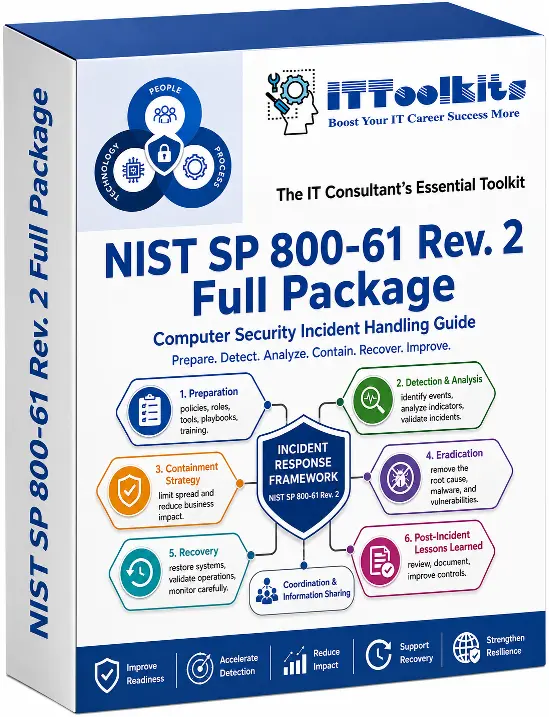
Cybersecurity incidents require fast, coordinated, and well documented action. The NIST 800-61 Incident Response Toolkits are important for organizations that need a structured and repeatable approach to preparing for, responding to, and recovering from security incidents.
Based on NIST 800-61 guidance, the package provides practical procedures, defined roles, response playbooks, investigation records, evidence tracking, reporting templates, and post incident review materials. These resources help turn incident response from an ad hoc reaction into a disciplined management process.
Using consistent incident response documentation can help teams improve coordination, accelerate escalation and response, strengthen evidence handling, support audit expectations, and build operational resilience across complex digital environments.
Below is a list of documents you will find in the toolkit. Click on index file button to see which templates are included.
| Type | Files List |
|---|---|
 Part 1. Incident Response Programme Initiation Part 1. Incident Response Programme Initiation📌 Objective: To establish the foundational governance, scope, objectives, planning approach, and programme structure required to initiate and manage an effective incident response capability aligned with organisational priorities and operational needs. | |
 | Incident Response Programme Charter.docx |
| Incident Response Policy.docx |
| Incident Response Framework.docx |
| Incident Response Governance Model.docx |
| Incident Response Scope Statement.docx |
| Incident Response Objectives and Principles.docx |
| Incident Response Programme Methodology.docx |
| Incident Response Implementation Strategy.docx |
| Incident Response Steering Committee Terms of Reference.docx |
| Incident Response Programme Communication Plan.docx |
 | Incident Response Roles and Responsibilities Matrix.xlsx |
| Incident Response RACI Matrix.xlsx |
| Incident Response Programme Plan.xlsx |
| Incident Response Roadmap.xlsx |
| Programme Milestone Tracker.xlsx |
 | Incident Response Programme Overview.pptx |
| Part 2. Regulatory, Legal, and Business Context 📌 Objective: To identify, assess, and document the legal, regulatory, contractual, and business context that shapes incident response obligations, reporting requirements, and stakeholder expectations across the organisation. | |
| Regulatory Compliance Mapping Standard.docx |
| Legal and Regulatory Obligation Assessment.docx |
| Incident Reporting Obligation Procedure.docx |
| Data Breach Assessment Guideline.docx |
| Stakeholder Requirement Analysis.docx |
| Cross Border Notification Guidance.docx |
| Business and Regulatory Context Summary.docx |
| Legal and Regulatory Requirements Register.xlsx |
| Incident Reporting Obligation Matrix.xlsx |
| Stakeholder Register.xlsx |
| Business Service Criticality Register.xlsx |
| Regulatory Deadline Tracker.xlsx |
| Compliance Gap Assessment.xlsx |
| Regulatory and Business Context Dashboard.pptx |
| Part 3. Governance, Operating Model 📌 Objective: To define the governance structure, operating model, decision authorities, and oversight mechanisms required to direct, supervise, and continuously improve incident response activities across the organisation. | |
| Incident Response Operating Model.docx |
| Incident Governance Standard.docx |
| Major Incident Management Standard.docx |
| Incident Escalation Governance Procedure.docx |
| Executive Oversight Protocol.docx |
| Incident Decision Making Authority Framework.docx |
| Governance Meeting Procedure.docx |
| Incident Review Committee Charter.docx |
| Governance Roles Matrix.xlsx |
| Decision Authority Matrix.xlsx |
| Escalation Governance Matrix.xlsx |
| Oversight Meeting Calendar.xlsx |
| Governance Action Log.xlsx |
| Governance Structure Overview.pptx |
| Part 4. Incident Response Team Structure and Resourcing 📌 Objective: To establish the incident response team structure, role definitions, contact arrangements, on call model, and resource planning needed to support coordinated and timely incident handling across internal and external stakeholders. | |
| Incident Response Team Charter.docx |
| Team Organisation Standard.docx |
| Analyst Role Profile.docx |
| Incident Commander Role Description.docx |
| Forensic Support Role Description.docx |
| Crisis Liaison Role Description.docx |
| On Call Management Procedure.docx |
| Resource Allocation Guideline.docx |
| Team Member Register.xlsx |
| Contact Directory.xlsx |
| Internal Escalation Contact List.xlsx |
| External Specialist Contact List.xlsx |
| On Call Roster.xlsx |
| Resource Availability Tracker.xlsx |
| Skills and Capability Matrix.xlsx |
| Team Structure Overview.pptx |
| Part 5. Asset, Service, and Dependency Baseline 📌 Objective: To document the assets, services, owners, dependencies, logging sources, and monitoring coverage necessary to support incident detection, impact assessment, prioritisation, and coordinated response across the technology environment. | |
| Asset Identification Standard.docx |
| Critical Service Identification Procedure.docx |
| Business Dependency Documentation Standard.docx |
| Logging Source Baseline Guideline.docx |
| Monitoring Coverage Standard.docx |
| Asset Ownership Register Procedure.docx |
| Enterprise Asset Inventory.xlsx |
| Critical System Register.xlsx |
| Business Service Register.xlsx |
| Application Dependency Register.xlsx |
| Data Classification Register.xlsx |
| Logging Source Inventory.xlsx |
| Monitoring Coverage Matrix.xlsx |
| Asset Criticality Heatmap.xlsx |
| Technology Environment Overview.pptx |
| Part 6. Risk, Threat, and Incident Scenario Planning 📌 Objective: To assess incident related risks, define threat scenarios, analyse likely threat actors, and prioritise response planning based on likelihood, impact, and treatment actions across the organisation's operating environment. | |
| Incident Risk Assessment Methodology.docx |
| Threat Scenario Development Guide.docx |
| Threat Modelling Procedure.docx |
| Incident Likelihood and Impact Assessment.docx |
| Sector Threat Assessment Template.docx |
| High Risk Scenario Definition Standard.docx |
| Threat Intelligence Requirement Document.docx |
| Incident Risk Register.xlsx |
| Threat Scenario Catalogue.xlsx |
| Threat Actor Profile Register.xlsx |
| Incident Likelihood and Impact Matrix.xlsx |
| Priority Scenario Ranking.xlsx |
| Risk Treatment Plan.xlsx |
| Threat and Scenario Landscape Overview.pptx |
| Part 7. Preparedness and Response Capability Planning 📌 Objective: To prepare the organisation for incident response through readiness assessments, capability planning, evidence preparation, tooling review, and secure communication arrangements that strengthen operational response effectiveness. | |
| Incident Response Preparedness Standard.docx |
| Operational Readiness Procedure.docx |
| Preparedness Assessment Checklist.docx |
| Evidence Readiness Procedure.docx |
| Tooling Readiness Standard.docx |
| Secure Communication Readiness Guide.docx |
| Readiness Review Worksheet.docx |
| Preparedness Action Plan.xlsx |
| Capability Readiness Tracker.xlsx |
| Tooling Inventory.xlsx |
| Secure Communication Channel Register.xlsx |
| Readiness Gap Log.xlsx |
| Response Capability Maturity Tracker.xlsx |
| Preparedness Status Dashboard.pptx |
| Part 8. Incident Detection and Event Triage 📌 Objective: To establish structured processes and records for detecting security events, triaging alerts, performing initial investigation, tuning detection logic, and improving the efficiency and accuracy of early incident identification. | |
| Incident Detection and Analysis Procedure.docx |
| Security Event Triage Standard.docx |
| Alert Handling Procedure.docx |
| Initial Investigation Checklist.docx |
| Case Intake Form.docx |
| Alert Escalation Guideline.docx |
| False Positive Review Procedure.docx |
| Detection Use Case Register.xlsx |
| Alert Prioritisation Matrix.xlsx |
| Triage Log.xlsx |
| Detection Rule Tuning Log.xlsx |
| False Positive Analysis Log.xlsx |
| Detection Coverage Tracker.xlsx |
| Detection and Triage Workflow.pptx |
| Part 9. Incident Classification and Case Management 📌 Objective: To define the criteria, workflow, ownership, and records used to classify incidents, declare cases, assign responsibility, track status, and manage the investigation queue in a consistent and controlled manner. | |
| Incident Classification Standard.docx |
| Incident Categorisation Procedure.docx |
| Incident Declaration Procedure.docx |
| Major Incident Declaration Checklist.docx |
| Case Handling Standard.docx |
| Case Ownership Procedure.docx |
| Initial Incident Assessment Form.docx |
| Incident Classification Matrix.xlsx |
| Incident Category Register.xlsx |
| Case Assignment Register.xlsx |
| Incident Case Log.xlsx |
| Incident Status Tracker.xlsx |
| Investigation Queue Tracker.xlsx |
| Incident Classification Model.pptx |
| Part 10. Escalation, Communication, and Notification 📌 Objective: To define escalation triggers, communication procedures, approval controls, and notification processes for internal, external, executive, customer, and regulatory stakeholders during incident response activities. | |
| Incident Escalation Procedure.docx |
| Internal Communication Procedure.docx |
| External Communication Procedure.docx |
| Executive Notification Template.docx |
| Regulatory Notification Assessment Form.docx |
| Customer Communication Template.docx |
| Media Holding Statement Template.docx |
| Communication Approval Procedure.docx |
| Escalation Threshold Matrix.xlsx |
| Notification Decision Log.xlsx |
| Communication Log.xlsx |
| Stakeholder Notification Tracker.xlsx |
| Approval Register.xlsx |
| Communication Escalation Flow.pptx |
| Part 11. Containment Strategy and Execution 📌 Objective: To support the planning, approval, execution, and review of containment actions that limit incident spread, protect critical services, and manage temporary control measures while balancing business impact considerations. | |
| Containment Management Procedure.docx |
| Short Term Containment Checklist.docx |
| Long Term Containment Checklist.docx |
| Isolation Approval Form.docx |
| Emergency Change Request for Incident Containment.docx |
| Business Impact Review Form.docx |
| Containment Decision Record.docx |
| Temporary Control Implementation Guideline.docx |
| Containment Action Log.xlsx |
| Service Impact Tracker.xlsx |
| Temporary Control Register.xlsx |
| Containment Readiness Tracker.xlsx |
| Containment Effectiveness Review.xlsx |
| Containment Strategy Overview.pptx |
| Part 12. Investigation and Digital Evidence Handling 📌 Objective: To provide structured methods, controls, and records for incident investigation, evidence preservation, forensic collection, chain of custody management, and documented analysis of indicators and findings. | |
| Incident Investigation Procedure.docx |
| Digital Evidence Handling Standard.docx |
| Chain of Custody Form.docx |
| Forensic Collection Checklist.docx |
| Evidence Preservation Procedure.docx |
| Investigation Interview Record.docx |
| Evidence Review Worksheet.docx |
| Investigation Findings Report.docx |
| Evidence Register.xlsx |
| Forensic Acquisition Log.xlsx |
| Interview Log.xlsx |
| Indicator of Compromise Register.xlsx |
| Timeline Analysis Worksheet.xlsx |
| Investigation Progress Tracker.xlsx |
| Digital Evidence Handling Flow.pptx |
| Part 13. Technical Analysis and Root Cause Determination 📌 Objective: To support technical analysis of incidents, determine root causes, assess control failures, understand attack paths, and document technical lessons that inform remediation and future response improvement. | |
| Root Cause Analysis Procedure.docx |
| Malware Analysis Worksheet.docx |
| Attack Path Analysis Template.docx |
| Compromise Assessment Form.docx |
| Control Failure Analysis Template.docx |
| Lessons from Technical Analysis Template.docx |
| Technical Findings Summary.docx |
| Root Cause Register.xlsx |
| Affected Asset Analysis.xlsx |
| Attack Timeline Tracker.xlsx |
| Control Failure Register.xlsx |
| Residual Threat Tracker.xlsx |
| Technical Analysis Dashboard.xlsx |
| Root Cause Summary Deck.pptx |
| Part 14. Eradication and Corrective Action Management 📌 Objective: To define the procedures, records, and validation activities required to eradicate malicious artefacts, execute corrective actions, restore secure configurations, and manage residual risks following incident containment and analysis. | |
| Eradication Procedure.docx |
| Corrective Action Procedure.docx |
| Malicious Artefact Removal Checklist.docx |
| Credential Recovery Procedure.docx |
| System Hardening Guideline.docx |
| Corrective Action Plan.docx |
| Remediation Validation Checklist.docx |
| Residual Risk Review Form.docx |
| Eradication Action Log.xlsx |
| Vulnerability Remediation Tracker.xlsx |
| Corrective Action Register.xlsx |
| Hardening Tracker.xlsx |
| Residual Risk Register.xlsx |
| Eradication and Remediation Status.pptx |
| Part 15. Recovery and Service Restoration 📌 Objective: To provide the framework, approvals, validation steps, and tracking records required to restore services safely, manage recovery risks, confirm normalisation, and monitor systems following incident remediation. | |
| Recovery and Restoration Procedure.docx |
| Service Restoration Standard.docx |
| Recovery Readiness Assessment.docx |
| Business Approval for Restoration Form.docx |
| Recovery Validation Checklist.docx |
| Post Recovery Monitoring Checklist.docx |
| Recovery Status Report.docx |
| Service Restoration Plan.xlsx |
| Recovery Milestone Tracker.xlsx |
| Recovery Risk Log.xlsx |
| Recovery Validation Tracker.xlsx |
| Service Normalisation Tracker.xlsx |
| Recovery Performance Metrics.xlsx |
| Recovery and Restoration Overview.pptx |
| Part 16. Major Incident and Crisis Management 📌 Objective: To define the escalation, command, executive coordination, communication, and closure arrangements required to manage major cyber incidents and crisis situations with timely leadership involvement and strategic control. | |
| Cyber Crisis Management Procedure.docx |
| Major Incident Command Procedure.docx |
| Crisis Activation Criteria.docx |
| Executive War Room Protocol.docx |
| Board Escalation Memo Template.docx |
| Crisis Situation Report Template.docx |
| Strategic Decision Record.docx |
| Crisis Closure Checklist.docx |
| Crisis Contact Register.xlsx |
| Crisis Decision Log.xlsx |
| Strategic Response Options Matrix.xlsx |
| Situation Reporting Tracker.xlsx |
| Crisis Communications Tracker.xlsx |
| Crisis Management Dashboard.pptx |
| Part 17. Third Party and Supply Chain Incident Coordination 📌 Objective: To manage incident coordination with third parties and suppliers through defined notification, escalation, shared responsibility, evidence request, and contractual review arrangements that support effective external collaboration. | |
| Third Party Incident Management Procedure.docx |
| Supplier Incident Notification Template.docx |
| Outsourced Service Incident Assessment Form.docx |
| Shared Responsibility Assessment.docx |
| Third Party Evidence Request Template.docx |
| Supplier Escalation Procedure.docx |
| Contractual Security Obligation Review.docx |
| Third Party Closure Report.docx |
| Supplier Register.xlsx |
| Third Party Incident Log.xlsx |
| Supplier Escalation Matrix.xlsx |
| Evidence Request Log.xlsx |
| Shared Responsibility Matrix.xlsx |
| Vendor Coordination Tracker.xlsx |
| Third Party Incident Oversight.pptx |
| Part 18. Documentation, Records, and Evidence Management 📌 Objective: To ensure incident related documentation, records, evidence files, versions, actions, and archived materials are controlled, retained, reviewed, and managed in a consistent and auditable manner. | |
| Incident Documentation Standard.docx |
| Record Management Procedure.docx |
| Evidence Retention Procedure.docx |
| Documentation Quality Review Checklist.docx |
| Meeting Minutes Template.docx |
| Decision Log Template.docx |
| Archive Transfer Form.docx |
| File Naming Convention Standard.docx |
| Incident Document Register.xlsx |
| Record Retention Schedule.xlsx |
| Evidence Archive Index.xlsx |
| Document Version Control Log.xlsx |
| Action Item Tracker.xlsx |
| Documentation Control Dashboard.pptx |
| Part 19. Metrics, KPIs, KRIs, and Management Reporting 📌 Objective: To define and maintain the metrics, indicators, trend analysis, and management reporting outputs required to monitor incident response performance, risk exposure, control effectiveness, and executive oversight. | |
| Incident Metrics Framework.docx |
| KPI and KRI Definition Standard.docx |
| Reporting Procedure.docx |
| Management Reporting Template.docx |
| Executive Reporting Guideline.docx |
| Trend Analysis Standard.docx |
| Monthly Reporting Calendar.docx |
| KPI Catalogue.xlsx |
| KRI Catalogue.xlsx |
| Incident Volume Tracker.xlsx |
| Mean Time Metrics Tracker.xlsx |
| Root Cause Trend Analysis.xlsx |
| Control Effectiveness Scorecard.xlsx |
| Escalation Performance Tracker.xlsx |
| Executive KPI Summary.pptx |
| Monthly Incident Management Report.pptx |
| Part 20. Audit Readiness, Assurance 📌 Objective: To support audit readiness, control assurance, evidence availability, management review, and programme effectiveness assessment through structured review procedures, findings records, and strategic improvement documentation. | |
| Incident Response Assurance Procedure.docx |
| Internal Audit Readiness Checklist.docx |
| Control Assurance Review Template.docx |
| Evidence Readiness Assessment.docx |
| Programme Self Assessment Questionnaire.docx |
| Management Review Procedure.docx |
| Annual Programme Effectiveness Report.docx |
| Strategic Improvement Memo.docx |
| Assurance Findings Register.xlsx |
| Evidence Readiness Register.xlsx |
| Audit Request Log.xlsx |
| Programme Review Action Tracker.xlsx |
| Management Review Calendar.xlsx |
| Assurance and Review Dashboard.pptx |
Price: $296.00

Secure payment via PayPal. Instant digital delivery after successful payment.


| Date File Updated | 25/03/2025 |
|---|---|
| File Format | pdf, xls, doc |
| No. of files | 288 Files, 20 Folders |
| File download size | 7.85 MB (.rar) |
| Language |  English English |
This document has been certified by a professional.
100% customizable. You can edit our templates as needed.
Instant download after completing your order.
We recommend downloading this file onto your computer.
Your payment information is processed securely.
After payment, if you require an invoice, please email us.
Support contact: supports@it-toolkits.org