
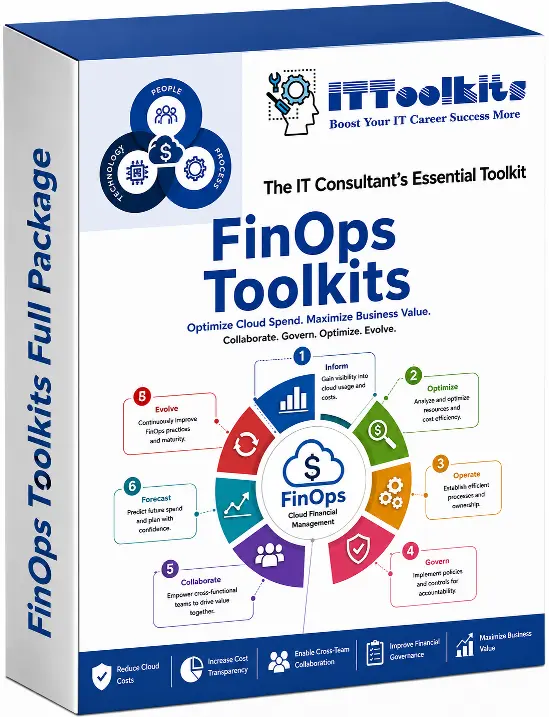
FinOps Implementation Toolkits

Effective cloud financial management is essential as cloud usage expands across teams, services, and business units.

FinOps Implementation Toolkits
FinOps_Cover Toolkits Full Package

Effective cloud financial management is essential as cloud usage expands across teams, services, and business units. The FinOps Implementation Toolkits help organisations build a structured approach to cloud cost visibility, accountability, budgeting, forecasting, and optimisation so financial decisions can keep pace with technical change.

The package brings together templates, checklists, trackers, dashboards, governance documents, and planning tools that support collaboration between finance, technology, procurement, and business teams. These resources help standardise the way cloud spending is reviewed, allocated, governed, and connected to business value.

Using the toolkit gives organisations a practical foundation to reduce waste, strengthen spending accountability, improve financial discipline, and mature FinOps practices while supporting scalable cloud growth and continuous improvement.

Benefits of This Toolkit
  • Improve cloud cost visibility
  • Strengthen spending accountability
  • Support better budgeting and forecasting
  • Reduce cloud waste and overspending
  • Enable faster cost optimisation
  • Standardise FinOps governance
  • Improve finance and engineering collaboration
  • Provide ready to use templates and trackers
  • Link cloud spending to business value
  • Support scalable cloud financial management
  • Reduce financial and operational risk
  • Accelerate FinOps maturity.
Toolkit Documents

Below is a list of documents you will find in the toolkit. Click on index file button to see which templates are included.

TypeFiles List
Part 1. FinOps Engagement Initiation & Executive Alignment
📌 Objective: To establish the foundation for a successful FinOps implementation by defining engagement scope, executive sponsorship, business case, stakeholder alignment, success criteria, assumptions, constraints, governance expectations, and the initial roadmap required to mobilize the programme effectively.
FinOps Engagement Charter.docx
Executive Sponsorship Brief.docx
FinOps Business Case.docx
Stakeholder Interview Guide.docx
FinOps Scope Definition Document.docx
FinOps Implementation Assumptions and Constraints.docx
FinOps Success Criteria Document.docx
Stakeholder Register.xlsx
Engagement Milestone Tracker.xlsx
Initial Cloud Spend Baseline.xlsx
FinOps Implementation RAID Log.xlsx
FinOps Decision Log.xlsx
Executive Kickoff Presentation.pptx
FinOps Vision and Case for Change.pptx
FinOps Implementation Roadmap Overview.pptx
Part 2. Current State Assessment & Discovery
📌 Objective: To assess the current cloud financial management environment, evaluate FinOps maturity, understand existing billing structures, governance practices, cost ownership, tooling, tagging, and consumption patterns, and identify gaps that must be addressed during implementation.
FinOps Current State Assessment Report.docx
Cloud Financial Management Discovery Questionnaire.docx
Cloud Operating Model Assessment.docx
Cloud Billing and Account Structure Assessment.docx
Cloud Governance Assessment.docx
FinOps Capability Assessment.docx
FinOps Maturity Assessment Report.docx
FinOps Capability Maturity Matrix.xlsx
Cloud Account Inventory.xlsx
Subscription and Project Inventory.xlsx
Cloud Service Consumption Inventory.xlsx
Existing Tagging and Labeling Inventory.xlsx
Cloud Cost Ownership Mapping.xlsx
Cost Management Tooling Inventory.xlsx
FinOps Gap Analysis Matrix.xlsx
Current State Findings Presentation.pptx
FinOps Maturity Assessment Presentation.pptx
Executive Assessment Readout.pptx
Part 3. Target Operating Model & Governance Design
📌 Objective: To design the FinOps target operating model, governance framework, decision rights, roles, responsibilities, council structure, policies, escalation paths, approval mechanisms, and performance indicators required to embed cloud financial accountability across the organisation.
FinOps Target Operating Model.docx
FinOps Governance Framework.docx
FinOps Roles and Responsibilities.docx
FinOps RACI Model.docx
FinOps Council Charter.docx
Cloud Financial Governance Policy.docx
Cost Accountability Policy.docx
Cloud Cost Approval Policy.docx
FinOps Escalation Model.docx
FinOps RACI Matrix.xlsx
Governance Meeting Cadence Tracker.xlsx
Cloud Cost Approval Matrix.xlsx
Policy Compliance Tracker.xlsx
FinOps Governance KPI Tracker.xlsx
FinOps Operating Model Design.pptx
FinOps Governance Model Presentation.pptx
FinOps Council Launch Presentation.pptx
Part 4. Cost Allocation, Tagging & Chargeback Design
📌 Objective: To establish a consistent cost allocation, tagging, labeling, cost center mapping, showback, chargeback, and shared cost distribution model that improves cloud spend transparency, business accountability, reporting accuracy, and financial ownership across teams and services.
Cost Allocation Strategy.docx
Tagging and Labeling Standard.docx
Cost Center Mapping Standard.docx
Shared Cost Allocation Policy.docx
Chargeback and Showback Policy.docx
Cloud Cost Ownership Model.docx
Tagging Exception Handling Procedure.docx
Tagging Taxonomy Matrix.xlsx
Mandatory Tag Compliance Tracker.xlsx
Cost Center Mapping Workbook.xlsx
Business Unit Allocation Matrix.xlsx
Shared Cost Allocation Calculator.xlsx
Showback Report Template.xlsx
Chargeback Report Template.xlsx
Tag Remediation Tracker.xlsx
Cost Allocation Design Presentation.pptx
Tagging Standard Enablement Presentation.pptx
Showback and Chargeback Model Presentation.pptx
Part 5. FinOps Data, Reporting & Analytics Design
📌 Objective: To design the FinOps reporting, analytics, dashboard, KPI, anomaly reporting, cost data model, and executive reporting framework required to provide reliable cloud cost visibility, performance insights, trend analysis, and actionable decision support across the organisation.
FinOps Reporting Strategy.docx
Cloud Cost Data Model Specification.docx
FinOps Dashboard Requirements.docx
Cost Reporting Operating Procedure.docx
Anomaly Reporting Procedure.docx
Executive Cost Reporting Standard.docx
FinOps KPI Catalogue.xlsx
Dashboard Requirements Matrix.xlsx
Cloud Cost Data Dictionary.xlsx
Cost Reporting Calendar.xlsx
Monthly Cost Performance Report.xlsx
Executive Cost Summary Template.xlsx
Business Unit Cost Report.xlsx
Cost Anomaly Register.xlsx
Cost Trend Analysis Workbook.xlsx
FinOps Dashboard Design Walkthrough.pptx
Executive Cost Report Presentation.pptx
Monthly FinOps Review Presentation.pptx
Part 6. Budgeting, Forecasting & Planning
📌 Objective: To establish practical cloud budgeting, forecasting, variance management, demand planning, budget ownership, and annual planning processes that help organisations improve financial predictability, manage consumption growth, and align cloud investment with business priorities.
Cloud Budgeting Framework.docx
Cloud Forecasting Methodology.docx
Budget Ownership Policy.docx
Forecast Variance Management Procedure.docx
Annual Cloud Planning Guide.docx
Cloud Demand Planning Process.docx
Cloud Budget Template.xlsx
Monthly Forecast Template.xlsx
Rolling Forecast Workbook.xlsx
Forecast Variance Analysis.xlsx
Business Unit Budget Tracker.xlsx
Product Budget Tracker.xlsx
Cloud Demand Planning Workbook.xlsx
Budget Exception Register.xlsx
Cloud Budget Planning Presentation.pptx
Forecast Review Presentation.pptx
Annual Cloud Financial Planning Presentation.pptx
Part 7. Optimization Management
📌 Objective: To define and manage cloud cost optimization practices including rightsizing, idle resource remediation, storage optimization, commitment discounts, reserved instances, savings plans, license optimization, exception handling, savings validation, and optimization backlog management.
Cloud Cost Optimization Strategy.docx
Rightsizing Procedure.docx
Idle Resource Management Procedure.docx
Storage Optimization Procedure.docx
Commitment Discount Strategy.docx
Reserved Instance Management Procedure.docx
Savings Plan Management Procedure.docx
License Optimization Procedure.docx
Optimization Exception Policy.docx
Optimization Opportunity Register.xlsx
Rightsizing Recommendation Tracker.xlsx
Idle Resource Remediation Tracker.xlsx
Storage Optimization Tracker.xlsx
Commitment Coverage Analysis.xlsx
Reserved Instance Portfolio Tracker.xlsx
Savings Plan Portfolio Tracker.xlsx
License Optimization Tracker.xlsx
Optimization Savings Validation Workbook.xlsx
Optimization Backlog.xlsx
Optimization Strategy Presentation.pptx
Optimization Opportunity Review Presentation.pptx
Savings Realization Presentation.pptx
Part 8. Engineering Enablement & Workload Accountability
📌 Objective: To enable engineering, architecture, and product teams to take ownership of cloud cost outcomes through cost aware design practices, workload accountability, unit economics, architecture cost reviews, operational standards, scorecards, and actionable cost improvement tracking.
Engineering FinOps Playbook.docx
Workload Cost Ownership Guide.docx
Cloud Cost Design Review Checklist.docx
Architecture Cost Review Procedure.docx
Unit Economics Definition Guide.docx
Product Cost Accountability Model.docx
FinOps Engineering Standards.docx
Workload Cost Ownership Matrix.xlsx
Architecture Cost Review Checklist.xlsx
Unit Cost Model Workbook.xlsx
Product Cost KPI Tracker.xlsx
Engineering Cost Action Tracker.xlsx
Workload Efficiency Scorecard.xlsx
Engineering FinOps Enablement Presentation.pptx
Cost Aware Architecture Training Presentation.pptx
Unit Economics Training Presentation.pptx
Part 9. Automation, Tooling & Integration
📌 Objective: To define the FinOps tooling, automation, integration, alerting, anomaly detection, budget monitoring, optimization runbook, and implementation requirements needed to improve scalability, operational efficiency, cost governance, and measurable benefits realization.
FinOps Tooling Strategy.docx
Cloud Cost Management Tool Requirements.docx
FinOps Automation Design Document.docx
Anomaly Detection Automation Procedure.docx
Budget Alerting Design.docx
Cost Optimization Automation Runbook.docx
FinOps Integration Architecture.docx
Tool Evaluation Matrix.xlsx
FinOps Automation Use Case Backlog.xlsx
Alert Configuration Register.xlsx
Integration Requirements Matrix.xlsx
Tool Implementation Tracker.xlsx
Automation Benefits Tracker.xlsx
FinOps Tooling Recommendation Presentation.pptx
Automation Roadmap Presentation.pptx
Tool Implementation Steering Presentation.pptx
Part 10. Risk, Compliance & Control
📌 Objective: To establish risk, compliance, control, audit readiness, procurement control, commitment approval, policy exception, and evidence management practices that help organisations govern cloud spend, reduce financial exposure, and maintain effective FinOps control assurance.
FinOps Risk Management Framework.docx
Cloud Cost Control Framework.docx
Cloud Spend Compliance Policy.docx
Procurement and Commitment Control Procedure.docx
Cloud Cost Audit Procedure.docx
FinOps Control Testing Procedure.docx
Policy Exception Management Procedure.docx
FinOps Risk Register.xlsx
Cloud Cost Control Matrix.xlsx
Policy Exception Register.xlsx
Commitment Approval Tracker.xlsx
Cost Compliance Scorecard.xlsx
Audit Evidence Tracker.xlsx
Control Testing Tracker.xlsx
FinOps Risk and Control Presentation.pptx
Compliance Review Presentation.pptx
Audit Readiness Presentation.pptx
Part 11. Change Management, Communication
📌 Objective: To support successful FinOps adoption through structured change management, stakeholder engagement, communication planning, role based training, community of practice development, awareness activities, adoption measurement, and enablement resources for finance, engineering, executives, and business owners.
FinOps Change Management Plan.docx
FinOps Communication Plan.docx
FinOps Training Plan.docx
Stakeholder Adoption Plan.docx
FinOps Community of Practice Charter.docx
Role Based Enablement Guide.docx
FinOps FAQ Document.docx
Change Impact Assessment.xlsx
Training Attendance Tracker.xlsx
Stakeholder Engagement Tracker.xlsx
Communication Calendar.xlsx
Adoption KPI Tracker.xlsx
FinOps Enablement Backlog.xlsx
FinOps Awareness Presentation.pptx
Executive Enablement Presentation.pptx
Finance Team Training Presentation.pptx
Engineering Team Training Presentation.pptx
Business Owner Training Presentation.pptx
Part 12. Pilot Implementation & Rollout
📌 Objective: To plan, execute, measure, and scale FinOps implementation through pilot selection, pilot execution, benefits tracking, issue management, rollout waves, business unit onboarding, hypercare support, and enterprise wide adoption governance.
FinOps Pilot Plan.docx
Pilot Selection Criteria.docx
Pilot Execution Playbook.docx
Pilot Exit Criteria.docx
Rollout Strategy.docx
Enterprise Rollout Plan.docx
Hypercare Support Model.docx
Pilot Candidate Assessment Matrix.xlsx
Pilot Execution Tracker.xlsx
Pilot Benefits Tracker.xlsx
Pilot Issue Log.xlsx
Rollout Wave Plan.xlsx
Business Unit Onboarding Tracker.xlsx
Hypercare Issue Tracker.xlsx
Pilot Kickoff Presentation.pptx
Pilot Results Presentation.pptx
Enterprise Rollout Plan Presentation.pptx
Rollout Steering Committee Presentation.pptx

Price: $196.00

PayPal Cards

Secure payment via PayPal. Instant digital delivery after successful payment.

Download index filePayment guide

Date File Updated25/03/2025
File Formatpdf, xls, doc
No. of files210 Files, 12 Folders
File download size70.25 MB (.rar)
LanguageEnglish English

This document has been certified by a professional.

100% customizable. You can edit our templates as needed.

Instant download after completing your order.

We recommend downloading this file onto your computer.

Your payment information is processed securely.

After payment, if you require an invoice, please email us.

Support contact: supports@it-toolkits.org

FINOPS IMPLEMENTATION TOOLKIT

Bring structure and accountability to cloud financial management.

Practical templates for cost visibility, budgeting, forecasting, allocation, optimisation, governance, reporting, and continuous FinOps improvement.

FAQs

1. Who are these toolkits designed for?

The toolkits available on IT-Toolkits.org are specifically designed for professionals, managers, and leaders in the fields of information technology and digital transformation, including but not limited to:

  • CIO (Chief Information Officer)

  • CTO (Chief Technology Officer)

  • CISO (Chief Information Security Officer)

  • CAIO (Chief AI Officer)

  • CDO (Chief Digital Officer)

  • IT Managers, Governance Officers, and Compliance Specialists

  • IT auditors, risk management professionals, cybersecurity teams

  • Digital transformation consultants and ISO/COBIT/ITIL implementation specialists

  • Corporate trainers and lecturers delivering internal workshops or professional training programs

These toolkits are suitable for:

  • Large enterprises operating complex IT systems or aligning with international frameworks

  • Small and medium sized enterprises (SMEs) building standardized IT governance and digital systems

  • Training institutions, research organizations, and independent consultants in need of Ready for Using, structured implementation tools

2. What does each toolkit include?

Each toolkit on IT-Toolkits.org is built with a comprehensive, practical, and structured framework tailored to real world enterprise usage. Depending on the theme (CIO, CTO, CISO, CAIO, Digital Transformation, ISO 27001, etc.), a typical toolkit includes:

🔹 1. Management Templates (Word files)

  • Dozens to hundreds of editable templates: policies, procedures, plans, checklists, reports

  • Organized by topic for easy navigation

  • Fully customizable to fit your organization's needs

🔹 2. Analytical & Governance Spreadsheets (Excel files)

  • KPI dashboards, risk matrices, budget planning sheets, scoring models

  • Equipped with formulas, charts, and dynamic tables for automated calculations

🔹 3. Professional Presentation Slides (PowerPoint files)

  • Ready for Using slides for internal communication, training, or executive briefings

  • Professionally designed and brand customizable

🔹 4. User Guides & Application Notes

  • Detailed instructions explaining the purpose and use case of each document

  • Guidance on how to adapt the materials based on industry and organizational structure

3. How many templates/documents are included in each toolkit?

The number of documents varies by toolkit, but most are developed as comprehensive, in depth packages tailored to different roles and objectives:

Functional Role Based Toolkits (CIO, CTO, CISO, CAIO, etc.):

  • 80-150 Word templates organized into 8-15 modules

  • 30-50 Excel dashboards, analysis sheets, financial models

  • 20-40 PowerPoint presentations for strategy, training, or communication

International Standards Toolkits (ISO 27001, COBIT, ITIL, GDPR...):

  • 100-200 standardized documents mapped to clauses or control objectives

  • Templates linked directly to audit/compliance requirements

Digital Transformation & AI Toolkits:

  • 70-120 specialized templates for assessing readiness, planning AI initiatives, managing risk, and tracking performance

4. Can I preview the content before purchasing?

Yes. We understand that reviewing content before purchase is important for informed decision making. Therefore, on each toolkit's product page, we provide:

  • Sample screenshots of templates, dashboards, or slides

  • Full list of included files with module names and file IDs

  • For selected toolkits, free downloadable samples or sample previews upon request

If you require a preview of specific documents or modules before purchasing, feel free to contact us via email or the website form. Our support team will respond promptly with tailored assistance.

5. Are these toolkits suitable for small and medium sized businesses (SMEs)?

Absolutely. The toolkits are built with flexibility and scalability, making them suitable not only for large enterprises but also for SMEs that are:

  • Building foundational IT governance systems

  • Standardizing cybersecurity and compliance processes

  • Launching digital transformation or AI adoption initiatives

  • Seeking practical, Ready for Using materials without large consulting budgets

Key benefits for SMEs:

  • Easy to use templates that can be selectively applied

  • No complex systems required - just Word, Excel, and PowerPoint

  • Significant cost and time savings compared to hiring consultants

  • Step by step guidance to empower internal IT and leadership teams

6. What file formats are used in the toolkits? (Word, Excel, PowerPoint?)

All documents are provided in fully editable, standard office formats, compatible with widely used software such as Microsoft Office and Google Workspace.

Supported file types:

  • Microsoft Word (.docx):
    For policies, procedures, forms, SOPs, audit reports, etc.
    → Easy to edit, insert content, and tailor to your organizational structure.

  • Microsoft Excel (.xlsx):
    For dashboards, risk matrices, financial models, analytics, and scoring sheets
    → Built in formulas, charts, and conditional formatting included.

  • Microsoft PowerPoint (.pptx):
    For strategy presentations, internal training, communication slides
    → Professionally designed and ready for brand customization.

7. Are the templates editable?

Yes. All templates are 100% editable.

They are delivered in original, editable formats (Word, Excel, PowerPoint), giving users full flexibility to:

  • Customize the content to meet specific business needs (e.g., add/remove fields, modify titles, internal references)

  • Insert company logo, brand elements, and internal policies

  • Adjust layouts, colors, and languages to fit your organization's tone and culture

  • Apply across departments, projects, or branches with full flexibility

8. Are toolkit contents regularly updated? What is the update policy?

Yes. We regularly update all toolkits to keep pace with evolving technologies, regulatory changes, and updates to global standards (e.g., ISO, COBIT, ITIL, NIST).

🔄 Update policy:

  • All customers are notified by email when new updates are released

  • Minor updates (e.g., error corrections, improved instructions, minor enhancements) are free within 6-12 months of purchase (depending on the product)

  • Major updates (e.g., alignment with new versions of ISO/COBIT, content restructuring, additional modules) will be offered to previous customers at exclusive upgrade discounts

📌 Recommendation:
Keep your order confirmation email and reference ID to easily access update privileges in the future.

🎯 Our commitment is to ensure customers always have access to modern, comprehensive, and field tested tools to support successful implementation.

9. Can I use the templates immediately, or do I need to adjust them first?

You can start using them right away. All templates are designed based on international best practices and are structured for immediate deployment.

Key features:

  • Built with real world content and standard compliant structures

  • Come with usage instructions and practical context

  • Organized by thematic modules for step by step or full system deployment

However, to maximize relevance, we recommend:

  • ✏️ Adjusting certain fields (e.g., company name, department, KPIs, policies)

  • ✏️ Localizing formatting and language if needed for training or board level presentations

🎯 With their professional design and Ready for Using content, the toolkits help you reduce 60-80% of documentation time while ensuring consistency and quality in execution.

10. Do toolkits come with user guides or instructions?

Yes. Every toolkit includes a comprehensive set of user guides to help you implement effectively - even without prior consulting experience.

Guides typically include:

  • Toolkit overview: Use cases, target users, structure, and application areas

  • How to use each document type: Purpose, real life use cases, and rollout steps

  • Customization guidance: How to adapt the templates for your business size, industry, or internal policies

  • Workflow diagrams (if applicable): Showing logical connections among templates

  • Recommended implementation sequence: Step by step instructions for deploying by topic or by phase

🎯 Our goal is not just to provide professional templates, but to ensure you know how to apply them effectively - with or without external consultants.

11. Are templates within one toolkit duplicated across other toolkits?

No, contents are not duplicated. Each toolkit on IT-Toolkits.org is purpose built for a specific role or governance function, ensuring no overlap between toolkits.

How we ensure content uniqueness:

  • Each toolkit is centered around a unique role or theme, such as CIO, CTO, CISO, CAIO, Digital Transformation, ISO 27001, etc.

  • Every template is written with specific use cases, responsibilities, and workflows of that role in mind.

  • The structure, fields, and metrics in each file are tailored to distinct business needs.

Example:
A "Technology Strategy Roadmap" in the CTO Toolkit is completely different from a "Digital Transformation Strategy" in the Digital Transformation Toolkit or an "AI Strategy Plan" in the CAIO Toolkit.

🎯 This role based structure enables users to combine multiple toolkits without content redundancy, creating a comprehensive enterprise management system.

12. Can I purchase only specific parts or individual sections of a toolkit?

By default, our toolkits are offered as complete, full featured packages to ensure:

  • Logical consistency and completeness across the full implementation process

  • A holistic view of the management or compliance framework

  • Avoiding gaps or missing critical templates by purchasing only partial content

🔄 However, in special cases, we can support:

  • Providing individual modules or sections (e.g., only the Risk Management section or only the Technology Strategy module)

  • Helping you select a tailored bundle based on your short term needs

📩 Please contact our support team via email or the contact form for a custom quote or to request a sample preview before making a decision.

13. What payment methods are accepted?

We support multiple secure and globally accepted payment methods to accommodate customers worldwide.

Accepted payment options include:

  • Credit/Debit Cards:
    Visa, Mastercard, American Express, JCB, and other major cards

  • PayPal:
    A secure and fast method for both individuals and businesses

  • Stripe:
    Built in checkout on our website, allowing direct card payments securely

  • Bank Transfer (upon request):
    For custom or bulk orders, we can provide manual bank transfer instructions as needed

🎯 Once payment is completed, you will automatically receive a confirmation email and secure download link within 15-60 minutes. If support is required, our team is available to assist promptly.

14. How will I receive the toolkit after payment?

As soon as your payment is successfully completed, the system will automatically redirect you to a secure download page where you can immediately download the full toolkit package.

✅ No need to wait for an email - the download page appears instantly after checkout.
✅ All files will be provided in a single ZIP archive or through a secure cloud hosted link.

📌 Important Note:
Please ensure that your browser does not block redirects after payment. If for any reason you are not redirected to the download page, kindly contact us at supports@it-toolkits.org - we will provide an alternative download link promptly.

🎯 This instant delivery method ensures you receive the toolkit quickly and securely, without delay.

15. Can I request an invoice or official billing document?

Yes. We can issue official invoices (electronic tax invoices) upon request for companies, organizations, or individuals who need to declare business expenses.

How to request an invoice:

  1. After completing payment, send an email to:
    📩 Supports@it-toolkits.org

  2. Include the following details:

    • Company/organization name

    • Tax identification number (if applicable)

    • Billing address

    • Email to receive the invoice

    • Special notes (if any)

    • Order reference number or payment confirmation

  3. Processing time:

    • Invoices are issued via email within 2-3 business days after we receive complete information.

📌 Invoices are issued by the official legal entity representing IT-Toolkits.org and comply with tax and financial regulations applicable to international businesses.

16. Can I get support if I have trouble using the templates?

Yes. We are committed to supporting our customers before, during, and after toolkit implementation.

Types of support available:

  • Email support:
    Send questions to 📩 supports@it-toolkits.org - we will reply within 24 business hours to help with usage, customization, or deployment.

  • Implementation guidance:
    We provide process flowcharts, usage notes, and recommendations to help users understand how to apply each group of templates.

  • Customization advisory:
    If your organization has unique industry or structural needs, our team of experts can suggest how to tailor templates accordingly.

  • Related materials recommendation:
    If the current toolkit doesn't fully meet your requirements, we can recommend complementary documents from our other toolkits.

🎯 Our mission goes beyond delivering templates - we aim to help you apply them effectively, achieve real results, and drive organizational value.

17. Who can I contact for advanced or specialized support?

If you need expert level support for using, customizing, or implementing our toolkits in your organization, our team of consultants is ready to assist.

Official support channels:

🛠 Specialized support may include:

  • Advisory on deploying toolkit components based on your roadmap

  • Template customization for specific industries (banking, manufacturing, logistics, public sector, etc.)

  • Full scale implementation support for ISO certification, IT governance programs, digital transformation, or AI deployment

🎯 We're not just a content provider - we are a trusted partner in helping you deliver successful execution and lasting impact.

18. What if a file doesn't work or I have trouble opening it?

All files are thoroughly tested before release to ensure compatibility with major office software. However, in rare cases, users may encounter issues. Here's how to resolve them:

Common issues and solutions:

  • File won't open or shows a format error:
    → Use Microsoft Office 2016+ or Google Workspace
    → Ensure the file was properly extracted if downloaded as a .zip

  • Excel files show macro or content warnings:
    → Click "Enable Editing" and "Enable Content" to activate features

  • Missing files or extraction issues:
    → Check your internet connection and re download the file
    → Contact us if the issue persists - we'll provide a new download link

📩 If you face any technical error, please email supports@it-toolkits.org with a brief description and a screenshot (if available).
👉 We are committed to resolving all technical issues within 24 business hours.